Certification Simplified: Viable Air & Surface Sampling in Compounding Pharmacies
- A. Peat
- Jul 3
- 6 min read
"The air may look clean—but looks can be deceiving."
When most people walk into a sterile compounding cleanroom, they notice how spotless everything appears. The floors shine, the stainless steel gleams, everyone is covered head-to-toe in gowns, and the air feels almost... different.
It certainly looks clean.
But here's the interesting part.
A cleanroom can look absolutely perfect while still containing microscopic living organisms that you can't see, smell, or feel.
That's where viable air and surface sampling comes in.
If non-viable particle counting tells us how clean the environment appears, viable sampling tells us whether anything alive is sharing the room with us.
Think of it this way.
Imagine you're buying a house.
A particle counter is like standing on the front lawn and saying, "The house looks beautiful."
Viable sampling is like opening the walls to see if there's mold growing inside.
Both inspections are important—but they answer completely different questions.
Let's simplify what viable sampling actually is, why pharmacies perform it, and what the results really mean.
First Things First… What Does "Viable" Mean?
The word viable simply means capable of living and growing.
In a cleanroom, we're interested in microorganisms such as:
Bacteria
Yeasts
Molds (fungi)
These organisms are invisible to the naked eye, but given the right conditions they can multiply and potentially contaminate sterile compounded medications.
The goal isn't to prove a room is sterile—because that's impossible.
The goal is to demonstrate that microbial contamination is being effectively controlled.
That's an important distinction.
Wait… Didn't We Already Test the Cleanroom?
This is probably the most common question we hear.
"Didn't the room already pass particle counts?"
Yes.
But particle counts and viable sampling are measuring two completely different things.
Imagine you're looking at a parking lot.
Particle counting tells you how many cars are in the parking lot.
Viable sampling tells you whether anyone is actually inside those cars.
One measures quantity.
The other measures life.
A particle counter detects microscopic particles floating through the air.
Those particles might be:
Dust
Skin flakes
Textile fibers
Water droplets
Smoke particles
A particle counter has absolutely no idea whether those particles are alive.
It simply counts them.
Viable sampling, on the other hand, is specifically looking for living microorganisms.
This is why a room can easily achieve an ISO Class 7 or ISO Class 8 particle classification while still producing microbial growth on an agar plate.
One result does not predict the other.
So How Does Viable Air Sampling Work?
The process is surprisingly simple.
A specialized microbiological air sampler draws a measured volume of air through a perforated sampling head.
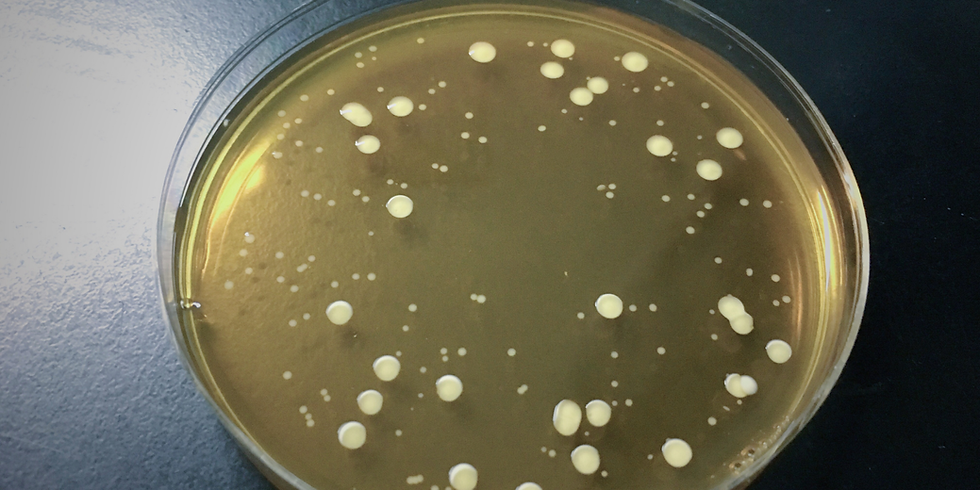
As the air passes through the sampler, any microorganisms present impact onto the surface of a sterile agar plate.
Think of the agar plate like a miniature buffet for bacteria.
If living microorganisms land on the media, and the incubation conditions are right, they'll begin to grow into visible colonies over several days.
After incubation, the microbiology laboratory counts the colonies that developed.
Each visible colony is reported as a Colony Forming Unit (CFU).
One colony does not necessarily mean one individual bacterium.
Instead, it represents one viable organism—or a small cluster of organisms—that was capable of growing into a visible colony.
Surface Sampling: Looking Where Microorganisms Like to Land
Air isn't the only place microorganisms travel.
Eventually, gravity wins.
Particles settle onto work surfaces, equipment, floors, counters, and other areas throughout the cleanroom.
Surface sampling evaluates how effective cleaning and disinfection practices are at controlling this contamination.
Most pharmacies perform surface sampling using sterile contact plates (often called RODAC plates).
Imagine gently pressing an ink stamp onto paper.
Instead of transferring ink, the agar surface gently touches the cleanroom surface.
If microorganisms are present, they're transferred onto the media.
Following incubation, any microbial growth becomes visible and can be counted.
Surface sampling may also be performed using sterile swabs when testing irregular or difficult-to-reach surfaces.
Where Are Samples Typically Collected?
Sampling locations are selected based on risk.
Common locations include:
Primary Engineering Controls (PECs)
Biological Safety Cabinets
Laminar Airflow Workbenches
Compounding Aseptic Isolators
Countertops
Pass-through chambers
Equipment surfaces
Floors
Walls
Frequently touched areas
Higher-risk locations generally receive more attention than areas with minimal product exposure.
Why Not Just Sample Everywhere?
If you've ever stepped on a LEGO barefoot, you know that just because something happened once doesn't mean every square inch of your house is dangerous.
The same principle applies to environmental monitoring.
Sampling is intended to represent the cleanroom—not test every square centimeter.
Quality teams establish routine monitoring locations based on:
Risk assessments
Historical trends
Workflow
Personnel movement
Regulatory guidance
Previous microbial findings
Over time, these results build a picture of how consistently the cleanroom performs.
What Happens After the Samples Leave the Pharmacy?
This is where patience becomes part of science.
Unlike particle counting, viable sampling doesn't produce immediate results.
The agar plates are sent to a microbiology laboratory where they are incubated under controlled conditions.
During incubation, any viable microorganisms begin to multiply.
After the appropriate incubation period, trained microbiologists count the colonies and identify organisms when required.
This process explains why viable sampling results usually aren't available the same day as certification.
Growing bacteria simply refuses to be rushed.
What Does a Positive Result Mean?
Here's where many people become unnecessarily concerned.
Finding microbial growth does not automatically mean the cleanroom has failed.
Think of a smoke detector.
Burning toast triggers the alarm.
Your house isn't on fire—but the alarm is telling you something deserves attention.
Microbial growth works the same way.
A result must always be interpreted within context.
Questions the Quality team may ask include:
Was the result above the facility's alert or action limit?
Has this organism been seen before?
Is there an increasing trend?
Was unusual work occurring that day?
Were cleaning procedures followed?
Were personnel practices appropriate?
Does the result correlate with other environmental monitoring data?
Environmental monitoring is much more like reading a weather forecast than flipping a light switch.
It's about recognizing patterns—not reacting to a single number in isolation.
Who Decides if the Result is Acceptable?
This is one of the biggest misconceptions surrounding cleanroom certification.
The certification company performs the sampling using validated procedures and submits the samples to an accredited microbiology laboratory.
However, the interpretation of the microbiological results belongs to the pharmacy's Quality Assurance (QA) program.
Why?
Because QA has the complete picture. They evaluate the results in the context of:
Regulatory requirements (such as the NAPRA Model Standards)
The pharmacy's Environmental Monitoring Program
Established alert and action limits
Historical trending
Cleaning and disinfection records
Personnel training and aseptic technique
Recent maintenance or facility changes
Production activities occurring during sampling
Previous investigations and corrective actions
For example, finding a single colony-forming unit (CFU) does not automatically indicate a failed cleanroom. QA must determine whether the result falls within the facility's established limits, whether it represents an unusual trend, and whether any investigation or corrective action is warranted.
Certification provides important environmental monitoring data.
Quality Assurance—using applicable regulatory standards such as NAPRA together with the facility's own procedures and historical data—determines what that data means and what actions, if any, should follow.
Why Viable Sampling Matters
Imagine trying to judge a person's health using only their body temperature.
A normal temperature is encouraging—but it doesn't tell the whole story.
You'd probably also want to know their blood pressure, heart rate, oxygen level, and medical history.
Cleanrooms are no different.
Particle counts, airflow measurements, pressure differentials, HEPA filter integrity testing, smoke studies, temperature, humidity, and viable sampling each provide one piece of a much larger picture.
No single test tells the entire story.
Together, they provide confidence that the environment is operating as intended.
The Big Picture
One of the greatest strengths of a cleanroom certification is that it evaluates multiple layers of environmental control.
Particle counts verify airborne cleanliness.
HEPA filter testing confirms filtration integrity.
Airflow testing verifies proper ventilation.
Pressure testing confirms room relationships.
Smoke studies visualize airflow patterns.
Viable sampling helps determine whether microorganisms are being effectively controlled.
Each test answers a different question.
Together, they help protect one very important thing:
The safety of every sterile medication prepared for a patient.
And that's ultimately what every cleanroom certification is about.
Not passing a test.
Protecting people.


Comments